
Legacy system modernization is the targeted process of upgrading or replacing outdated software and infrastructure so they reliably deliver current business outcomes. The goal is not change for its own sake. It is alignment: making your technology stack capable of supporting the speed, security, and scalability your business requires right now.
The cost of doing nothing is no longer theoretical. Outdated systems increase security exposure and can make cyber insurance harder to obtain, while maintenance spending on aging platforms crowds out the budget you need for AI adoption, cloud migration, and competitive feature delivery. Every quarter you delay, the gap between what your systems can do and what your business needs them to do widens.
Start here with three concrete actions:
- Run a quick portfolio assessment. Catalog your applications, flag those with unsupported languages, single-expert dependencies, or brittle integrations, and score each by business value and technical health.
- Choose a pilot phase of several months. Pick one application with high business value and well-contained dependencies. A bounded pilot validates your approach before you commit the full portfolio.
- Secure an executive sponsor and a budget window. Modernization projects that lack a named sponsor and a defined funding horizon stall at the first organizational friction point.
Table of Contents
- What counts as a legacy system and what modernization can include
- Why modernize? The business case in measurable terms
- What are the R's of modernization and how do you choose?
- How does a practical modernization roadmap work?
- What technical patterns and tools enable modernization?
- What are the most common modernization pitfalls and how do you avoid them?
- How do you measure modernization success?
- What do typical modernization scenarios look like?
- How does modernization differ from digital transformation?
- How do you start a modernization program in the first 90 days?
- How 168-ventures approaches modernization
- Key Takeaways
- The trade-off most IT leaders get wrong
- 168-ventures can run your modernization diagnostic
- Authoritative sources and further reading
What counts as a legacy system and what modernization can include
A system is not legacy simply because it is old. It is legacy when it is misaligned with current business needs: running on unsupported languages, dependent on a single engineer who holds all the institutional knowledge, or so tightly coupled that changing one component risks breaking three others. Age is a symptom, not the diagnosis.
Common legacy types include mainframe and COBOL applications that process core transactions but cannot expose APIs, monolithic web applications where every deployment is a full-system event, outdated ERP platforms that require expensive customization for every new integration, unsupported middleware that sits between modern and older systems as a fragile translation layer, and legacy databases that lack the performance or schema flexibility modern applications demand.
"Modernization" covers a wide spectrum of technical work. At the low-impact end, rehosting moves an application to a new environment with minimal code changes. Replatforming makes targeted optimizations, such as switching to a managed database service, without redesigning the application. Refactoring restructures code for maintainability and performance while preserving external behavior. Rearchitecting redesigns the application's structure, often breaking a monolith into services. Replacing swaps the system entirely, either with a SaaS product or a rebuilt application. Encapsulation wraps a legacy system behind an API layer so modern applications can consume it without touching the underlying code. Low-code rebuilds are increasingly practical for non-differentiating applications where speed of delivery matters more than bespoke functionality.
The right choice depends on how much business value the application delivers, how much technical debt it carries, and how much risk you can absorb during the transition.
Why modernize? The business case in measurable terms
The strongest argument for modernization is no longer feature enablement. It is the cost of inaction. Security exposure, inability to adopt AI, and the maintenance drain on engineering capacity have become the primary drivers, and each of those costs is measurable.
Tangible technical benefits include:
- Reduced maintenance cost. Teams maintaining legacy codebases spend a disproportionate share of their time on break-fix work rather than new capability delivery.
- Lower outage risk. Aging systems with undocumented dependencies are harder to recover when they fail, and failures are more frequent.
- Faster feature delivery. Modern CI/CD pipelines and decoupled architectures let teams ship changes in hours, not weeks.
- Improved scalability. Cloud-native and containerized workloads scale on demand rather than requiring hardware procurement cycles.
- Better security posture. Supported platforms receive patches. Unsupported ones do not.
On the business side, modernization unlocks new revenue streams through automation and AI integration, reduces customer onboarding friction, and shortens time-to-market for new products. Healthcare organizations that modernize patient data systems can connect to AI-assisted diagnostics. Logistics companies that replace legacy dispatch platforms gain real-time routing and predictive maintenance capabilities.
Statistic to know: The cost of inaction is rising — outdated systems not only increase security risk but can make cyber insurance harder to obtain, adding a direct, quantifiable financial liability to the status quo.
ROI calculations should include avoided outage costs, reduced licensing and maintenance fees, engineering hours recaptured from break-fix work, and the revenue value of features that were previously impossible to build. A realistic business case accounts for all four.
What are the R's of modernization and how do you choose?
The modernization strategy spectrum is most usefully framed as a set of R options, each representing a different level of change, risk, and potential return. Most real-world programs use a mix, matched to the business value and risk tolerance of each application.
The five core strategies
Rehost (lift-and-shift) moves an application to a new environment, typically cloud infrastructure, with no code changes. It is fast and reduces operational burden, but it may not unlock cloud-native benefits like auto-scaling or managed services. Use it for applications that need to exit an aging data center quickly, or as a first step before deeper work.
Replatform makes targeted optimizations without redesigning the application. Switching from a self-managed database to a managed cloud database service is a classic example. The effort is moderate, the risk is contained, and you capture meaningful operational improvements.
Refactor restructures existing code to improve maintainability, performance, or testability without changing external behavior. This is the right choice when the application's core logic is sound but the codebase has accumulated enough technical debt to slow delivery.
Rearchitect redesigns the application's structure, typically decomposing a monolith into microservices or an event-driven architecture. High effort, higher risk, but the payoff is a system that can scale and evolve independently. Reserve this for applications with high strategic value and clear long-term roadmaps.
Replace retires the existing system and substitutes a SaaS product or a rebuilt application. Low-code platforms and SaaS are pragmatic replacement strategies for non-differentiating applications where speed of delivery matters more than custom functionality.
Decision matrix: matching approach to context
| Factor | Rehost | Replatform | Refactor | Rearchitect | Replace |
|---|---|---|---|---|---|
| Business value | Low–Medium | Medium | Medium–High | High | Low (non-core) |
| Technical debt | Any | Moderate | High | Very high | Very high |
| Time-to-market pressure | High | Medium | Medium | Low | High |
| Team skills required | Low | Moderate | High | Very high | Low–Medium |
| Risk profile | Low | Low–Medium | Medium | High | Medium |
| Typical effort | Weeks | 1–3 months | 3–6 months | 6–18 months | 2–6 months |
Pro Tip: Pick your pilot candidate by crossing high business value with well-contained dependencies. An application that scores high on value but low on integration complexity gives you the best chance of a clean win that builds executive confidence for the rest of the program.
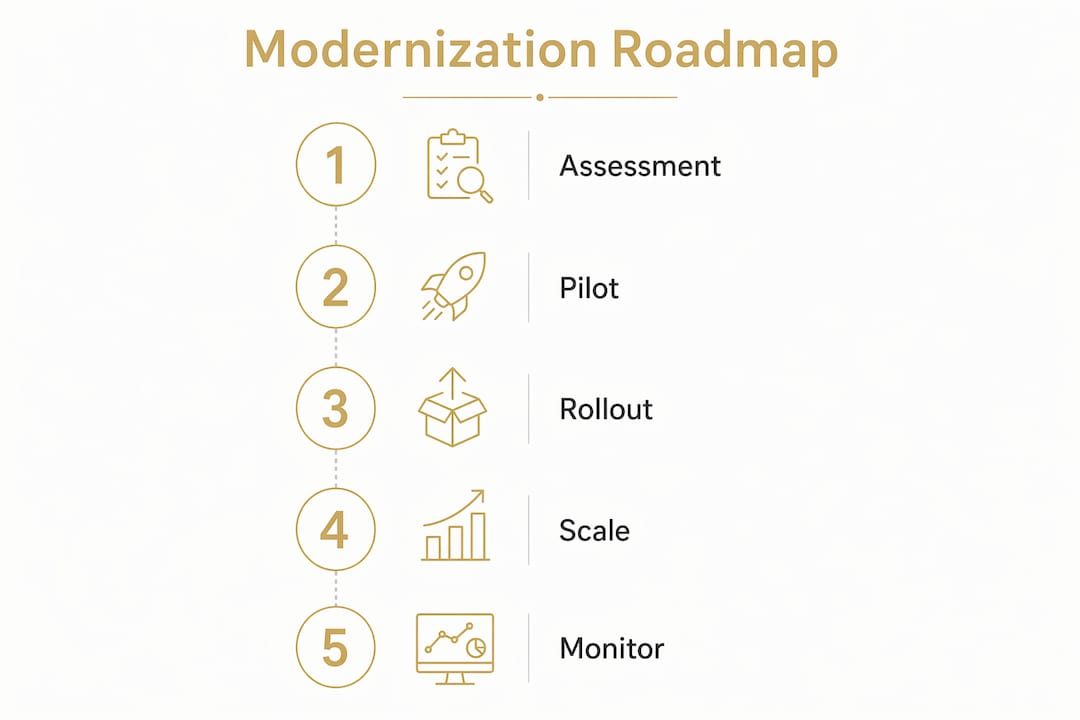
How does a practical modernization roadmap work?
A phased approach is the most reliable way to reduce risk, validate assumptions, and build organizational momentum. The AWS Prescriptive Guidance recommends a split-and-seed model: run a bounded pilot, prove the approach, then scale the team and capabilities across the portfolio.
Phase 1: Assessment (weeks 1–6)
The application portfolio assessment is the non-negotiable first step. Without it, you are making strategy decisions without data.
- Application inventory: catalog every system, its technology stack, vendor support status, and the team responsible for it.
- Dependency mapping: document integrations, data flows, and shared services. Hidden dependencies are the most common cause of unexpected downtime during migration.
- Business-value scoring: rate each application by revenue impact, customer-facing criticality, and strategic alignment.
- Technical health check: assess code quality, test coverage, documentation completeness, and deployment frequency.
- Compliance and risk scan: identify regulatory requirements (HIPAA, SOC 2, PCI-DSS) that constrain how and when you can migrate.
Deliverables: application inventory spreadsheet, dependency map, prioritized modernization backlog, compliance constraint register.
Phase 2: Pilot (weeks 7–22, typically 12–16 weeks)

Select one application from the top of your prioritized backlog. Define MVP goals and success criteria before writing a line of code. Set up your CI/CD baseline, observability tooling, and rollback plan before the pilot begins, not after.
Key pilot activities:
- Define go/no-go criteria tied to business metrics (deployment frequency, error rate, time-to-recover).
- Run test cases against the existing system to establish a behavioral baseline.
- Execute the modernization work in two-week sprints with a steering committee review at week 8 and a go/no-go gate at week 16.
- Document the rollback playbook and test it before go-live.
Phase 3: Rollout and scale
After a successful pilot, apply the split-and-seed approach: replicate the team structure, tooling, and runbooks across the next cohort of applications. Maintain change-control discipline, publish runbooks for each migrated system, and run training before decommissioning the legacy version.
Required artefacts: business case document, application runbook, rollback playbook, decommission plan, training materials.
What technical patterns and tools enable modernization?
Modern infrastructure patterns give you options that did not exist a decade ago. The right combination depends on your starting point, your target architecture, and how much disruption your business can absorb during the transition.
Core architectural patterns
The strangler fig pattern is the most widely used approach for incremental modernization. You build new functionality alongside the legacy system, route traffic to the new components, and gradually retire the old ones. Combined with an API façade, it lets you expose legacy functionality through a modern interface without touching the underlying code.
Domain decomposition breaks a monolith by business capability, creating independently deployable services. Event-driven design decouples services through message queues or event streams, reducing the tight coupling that makes legacy systems brittle. Serverless architectures are appropriate for stateless, event-triggered workloads where you want to eliminate infrastructure management entirely.
Containerization as a bridge strategy
Containerization is one of the most practical intermediate strategies available. Wrapping a legacy application in a container standardizes its runtime environment, makes it portable across cloud providers, and simplifies CI/CD pipeline integration. Critically, it keeps rollback options intact while you refactor incrementally. Kubernetes orchestration then gives you automated scaling, self-healing, and rolling deployments.
Statistic to know: Containerization standardizes deployment and increases portability, making it a viable bridge across multiple modernization paths, from rehosting to full rearchitecting.
Tooling by category
| Category | Examples | Primary use |
|---|---|---|
| Cloud platforms | Amazon Web Services (AWS), Microsoft Azure, Google Cloud Platform | Infrastructure, managed services, migration tooling |
| Container orchestration | Kubernetes, Amazon EKS, Azure Kubernetes Service, Google GKE | Workload management and scaling |
| CI/CD pipelines | GitHub Actions, GitLab CI, AWS CodePipeline, Azure DevOps | Automated build, test, and deploy |
| Database migration | AWS Database Migration Service, Azure Database Migration Service | Schema conversion and data transfer |
| API gateways | AWS API Gateway, Azure API Management, Google Cloud Apigee | Legacy encapsulation and traffic routing |
| Observability | Datadog, Prometheus, Grafana, AWS CloudWatch | Monitoring, alerting, and tracing |
| Security and IAM | AWS IAM, Azure Active Directory, HashiCorp Vault | Identity, secrets management, and access control |
Security and compliance checklist during migration
Modernizing applications without modernizing operations increases long-term cost. The AWS Prescriptive Guidance is explicit: CI/CD, observability, and security must be established in parallel with code changes, not bolted on afterward.
- Classify all data assets before migration (PII, PHI, financial records).
- Enforce encryption in transit and at rest for every migrated workload.
- Implement least-privilege IAM policies from day one.
- Enable audit logging and centralized log management before go-live.
- Validate compliance controls (HIPAA, SOC 2, PCI-DSS) in the pilot environment before production cutover.
- For hybrid environments, establish secure connectivity (VPN or private peering) and define clear data residency boundaries.
What are the most common modernization pitfalls and how do you avoid them?
Most modernization programs that fail do so for predictable reasons. Missing documentation and unidentified dependencies are the most frequent culprits. The fix is not heroic engineering. It is disciplined preparation.
Common challenges
- Missing documentation. Legacy systems often have no current architecture diagrams, no data dictionaries, and no runbooks. Teams discover this during migration, not before.
- Hidden dependencies. An application that appears self-contained often has undocumented integrations with shared databases, batch jobs, or third-party services.
- Data quality issues. Migrating data from a legacy system frequently surfaces inconsistencies, duplicates, and schema mismatches that were masked by application logic.
- Skills shortage. COBOL, older Java frameworks, and proprietary middleware require specialized knowledge that is increasingly scarce.
- Integration complexity. Modern systems need to coexist with legacy ones during the transition, creating hybrid integration challenges.
- Test coverage gaps. Legacy systems often have minimal automated test coverage, making it hard to validate that a migrated system behaves identically.
- Regulatory constraints. Compliance requirements can restrict when and how data is moved, slowing migration timelines.
Mitigation techniques
- Run automated dependency discovery tools before writing any migration code.
- Build a behavioral test suite against the legacy system before touching it, so you have a regression baseline.
- Use blue/green deployments or canary releases to limit blast radius during cutover.
- Document and test the rollback plan before go-live, not after.
- For skills gaps, consider a blended team model: pair internal engineers with specialists who know the legacy platform.
- Stage data migration with validation checkpoints, not a single big-bang cutover.
Risk matrix
| Risk | Likelihood | Impact | Mitigation | Trigger for contingency |
|---|---|---|---|---|
| Hidden dependencies cause outage | High | High | Dependency mapping, blue/green deploy | Unexpected service failure in staging |
| Data loss or corruption during migration | Medium | Very high | Staged migration, validation checkpoints | Data integrity check failure |
| Skills gap delays delivery | High | Medium | Blended team, training plan | Sprint velocity drops below threshold |
| Compliance violation during cutover | Low | Very high | Pre-migration compliance audit | Audit finding in pilot environment |
| Rollback fails under production load | Low | High | Rollback test in staging | Rollback drill failure before go-live |
How do you measure modernization success?
Measuring success starts before the pilot begins. Define your KPIs and baseline values during the assessment phase so you have a before-and-after comparison that is credible to executives and finance teams.
Recommended KPIs
| KPI | What it measures | Target direction |
|---|---|---|
| Mean time to deploy | Speed of delivery pipeline | Decrease |
| Lead time for change | Time from commit to production | Decrease |
| Defect escape rate | Quality of releases | Decrease |
| System uptime / MTTR | Reliability and recovery speed | Uptime up, MTTR down |
| Cost-to-serve per transaction | Operational efficiency | Decrease |
| Developer productivity | Features delivered per sprint | Increase |
| Time-to-market for key features | Business agility | Decrease |
ROI and cost items to include in your business case
A complete ROI model covers both sides of the ledger. On the savings side: reduced licensing and maintenance fees, avoided outage costs, engineering hours recaptured from break-fix work, and lower cyber insurance premiums. On the investment side: cloud run costs, staffing and retraining, tooling, and the consulting or delivery partner fees.
Statistic to know: Modernization programs that establish operational readiness (CI/CD, observability, security) in parallel with code changes avoid the hidden cost of retrofitting those capabilities later, which typically adds months and budget to a program.
Tie pilot metrics directly to the business case. If your pilot reduces mean time to deploy from three weeks to two days, extrapolate that improvement across the portfolio and express it in engineering hours and feature delivery cycles. That translation from technical metric to business outcome is what secures funding for the next phase.
Typical timelines: assessment takes 4–6 weeks, a pilot runs 12–16 weeks, and a full portfolio rollout spans 12–36 months depending on portfolio size and complexity. Budget ranges vary widely by scope, but the business case should always include a cost-of-inaction baseline to contextualize the investment.
What do typical modernization scenarios look like?
Three scenarios cover the most common starting points. Each illustrates a different strategy, a different risk profile, and a different set of outcomes.
Scenario 1: Lift-and-shift to cloud (rehost)
Before: A mid-size logistics company runs its dispatch management system on aging on-premises servers. The hardware is approaching end-of-life, the team spends significant time on infrastructure maintenance, and the system cannot scale during peak periods.

After: The application is rehosted on AWS EC2 with managed storage and networking. The hardware maintenance burden disappears, and the team reclaims engineering time previously spent on infrastructure.
Outcomes: Faster infrastructure provisioning, reduced operational overhead, and a stable foundation for future work. Deployment frequency and application architecture remain unchanged.
Lesson learned: Rehosting is a valid first step, but it does not change how the application is built or deployed. Teams that stop here often find themselves revisiting the same application 18 months later for refactoring or replatforming.
Scenario 2: Refactor and containerize (replatform + refactor)
Before: A healthcare organization runs a patient scheduling application as a monolithic Java application. Deployments require a full system restart, take four hours, and happen once a month. Any bug fix waits for the next release window.
After: The team refactors the scheduling module into independently deployable services, containerizes each with Docker, and deploys on Kubernetes via Azure Kubernetes Service. A CI/CD pipeline on Azure DevOps automates build, test, and deploy.
Outcomes: Deployment time drops from four hours to under 30 minutes. Release cadence moves from monthly to weekly. The team can ship bug fixes the same day they are identified.
Lesson learned: The investment in CI/CD and observability tooling before the first deployment paid for itself within two sprint cycles. Teams that skip this step spend the next quarter retrofitting it.
Scenario 3: Replace with SaaS (replace)
Before: A professional services firm runs a custom-built CRM on an unsupported framework. The system requires a dedicated developer to maintain it, integrates with nothing modern, and cannot support the mobile access the sales team needs.
After: The firm replaces the custom CRM with a modern SaaS platform, migrates historical data, and configures integrations with its email, billing, and project management tools.
Outcomes: The dedicated maintenance developer is redeployed to higher-value work. The sales team gains mobile access and real-time pipeline visibility. Integration with the billing system eliminates manual data entry.
Lesson learned: For non-differentiating applications, SaaS replacement is often faster and cheaper than refactoring. The key question is whether the application provides competitive differentiation. If it does not, buy rather than build.
How does modernization differ from digital transformation?
These two terms are often used interchangeably, but they describe different scopes of work with different governance requirements and investment scales.
Legacy modernization is targeted technical work: upgrading or replacing specific systems to improve performance, security, and maintainability. The scope is defined by the application portfolio. The primary stakeholders are IT leaders, architects, and engineering teams. Success is measured in technical KPIs.
Digital transformation is broader. It rethinks business models, processes, and customer experiences, using technology as an enabler. It requires organizational change management, cross-functional program governance, and executive sponsorship at the board level. The scope extends beyond IT into operations, sales, finance, and HR.
When to treat the work as modernization: your project is technology-first, the scope is bounded by specific applications, and the business process remains largely unchanged. Governance sits with the CIO and IT leadership. Investment is measured in months and a defined budget envelope.
When to escalate to transformation: the project requires changes to how the business operates, not just how the technology works. New business models, new customer journeys, or cross-functional process redesign are involved. Governance requires a C-suite steering committee, a dedicated program office, and multi-year funding.
A practical recommendation: start with modernization. Prove the approach, build organizational capability, and use the results to make the case for broader transformation investment. Attempting transformation without the technical foundation that modernization provides is a common and expensive mistake.
How do you start a modernization program in the first 90 days?
A starter plan with clear deliverables makes it significantly easier to secure funding and executive buy-in. Here is a week-by-week playbook for CIOs and IT leaders.
-
Weeks 1–2: Kick off the inventory. Assign an application owner to every system in the portfolio. Collect technology stack, vendor support status, and business criticality for each. Schedule a stakeholder alignment meeting with the CIO, CFO, and key business unit leaders to frame the program's objectives.
-
Weeks 3–4: Complete dependency mapping. Run automated discovery tools across the network. Document integrations, data flows, and shared services. Identify the five applications with the highest combination of business value and integration complexity.
-
Weeks 5–6: Score and prioritize the portfolio. Apply a business-value and technical-health scoring model to every application. Produce a prioritized modernization backlog. Present the backlog and a draft business case to the steering committee for input.
-
Week 7: Select the pilot candidate. Choose the application at the top of the backlog that has the highest business value and the most contained dependencies. Confirm the pilot scope, success criteria, and go/no-go gates with the steering committee.
-
Weeks 8–9: Establish the security and compliance baseline. Complete the compliance constraint register. Set up IAM policies, audit logging, and encryption standards for the pilot environment. Confirm regulatory requirements with your legal and compliance team.
-
Weeks 10–11: Assign staff and finalize procurement. Confirm team assignments (internal engineers, specialists, delivery partner). Complete tooling procurement (CI/CD, observability, cloud accounts). Obtain budget sign-off for the pilot phase.
-
Week 12: Launch the pilot. Hold a pilot kickoff with the full team. Confirm the rollback plan is documented and tested. Begin sprint 1 with defined MVP goals and a week-8 steering committee review gate.
Steering committee cadence: bi-weekly during the pilot, monthly during rollout. Each session should include a metrics review against the defined KPIs, a risk and issues log review, and a go/no-go decision for the next phase.
Go/no-go signals at the pilot gate (week 16): deployment frequency meets target, error rate is at or below baseline, rollback plan has been tested successfully, and the business sponsor confirms the MVP meets the defined success criteria.
How 168-ventures approaches modernization
168-ventures brings a structured, diagnostic-first methodology to every modernization engagement. The approach is designed to reduce risk, accelerate time-to-value, and give leadership the evidence they need to make confident investment decisions.
The methodology follows five stages:
- Discovery diagnostic. A structured audit of the application portfolio, dependency map, business-value scoring, and compliance constraint register. This produces the prioritized modernization backlog that drives every subsequent decision.
- Prioritized roadmap. A phased plan that matches each application to the appropriate modernization strategy, with effort estimates, risk ratings, and milestone checkpoints.
- Pilot phase of several months. A bounded delivery engagement that builds an MVP, validates technical assumptions, and produces the KPI baseline for the business case.
- Split-and-seed scaling. After a successful pilot, 168-ventures replicates the team structure, tooling, and runbooks across the next cohort of applications, maintaining quality and pace as the program scales.
- Platform engineering and ongoing operations. Continued support for CI/CD, observability, security, and operational readiness as the modernized portfolio grows.
Trust signals built into every engagement:
- Portfolio assessment methodology using application inventory and business-value scoring, consistent with the approach recommended by the Microsoft Azure Cloud Adoption Framework and AWS Prescriptive Guidance.
- A documented risk and rollback plan, tested before every production cutover.
- A security and compliance checklist applied at the start of every pilot, covering data classification, encryption, IAM, and audit logging.
- Measurable KPIs defined during the assessment phase and tracked through every milestone.
168-ventures clients typically see a 3.2x improvement in pipeline within the first 90 days of engagement. The firm brings sector experience across healthcare, logistics, retail, professional services, and manufacturing. The Executive AI partner, Oracle, personalizes recommendations based on your specific business goals, so the modernization roadmap reflects your priorities, not a generic template.
Key Takeaways
Legacy system modernization succeeds when you start with a rigorous portfolio assessment, match each application to the right strategy, run a bounded pilot phase of several months, and measure outcomes against defined KPIs before scaling.
| Point | Details |
|---|---|
| Start with the portfolio assessment | Inventory, dependency mapping, and business-value scoring must come before any strategy decision. |
| Match strategy to context | Use the R's framework to select the minimal change that unlocks the target business value for each application. |
| Run a bounded pilot first | A pilot phase of several months validates assumptions and builds executive confidence before full portfolio commitment. |
| Measure before and after | Define KPIs during assessment so you have a credible before-and-after comparison for the business case. |
| 168-ventures delivers the diagnostic | 168-ventures' discovery diagnostic produces a prioritized roadmap and a 3.2x pipeline improvement within 90 days. |
The trade-off most IT leaders get wrong
The conventional wisdom on modernization says: pick the boldest approach your budget allows and move fast. In practice, that advice produces the most expensive failures.
The projects that deliver lasting value almost always start smaller than the team wanted. Not because ambition is wrong, but because the assessment phase consistently reveals that the portfolio is more complex, more interdependent, and less documented than anyone believed. A team that commits to a full rearchitecting program before completing a dependency map is making a multi-million-dollar bet on assumptions they have not tested.
The more useful question is not "how bold should we be?" but "what is the smallest change that unlocks the most business value?" For many applications, that answer is replatforming or containerization, not a ground-up rebuild. For a handful of strategically critical systems, rearchitecting is the right call, but only after the pilot has proven the team's capability and the organization's appetite for change.
One thing the evidence is clear on: teams that skip the operational foundation (CI/CD, observability, rollback planning) and focus only on the code changes pay for that shortcut in the next phase. The technical debt migrates from the application layer to the operations layer, and it is harder to see and harder to fix.
Start with the assessment. Pick a pilot candidate with high value and contained dependencies. Measure rigorously. Then scale what works.
Pro Tip: Prioritize the pilot candidate that sits at the intersection of high business value and well-contained dependencies. That combination gives you the cleanest signal about whether your approach works, and the most credible result to present to the executive team.
168-ventures can run your modernization diagnostic
If your systems are holding back delivery speed, security posture, or your ability to adopt AI, the fastest way forward is a structured diagnostic, not a lengthy RFP process. 168-ventures delivers a discovery diagnostic that produces a prioritized modernization backlog, a phased roadmap, and a pilot-ready business case, all within a defined engagement window.
The diagnostic covers application inventory, dependency mapping, business-value scoring, and a compliance constraint register. Oracle, the 168-ventures Executive AI partner, personalizes the roadmap recommendations to your specific business goals and sector context, whether you operate in healthcare, logistics, manufacturing, or professional services. Clients typically see a 3.2x improvement in pipeline within the first 90 days of engagement.
The next step is straightforward. Request a modernization diagnostic and leave the session with a prioritized backlog and a pilot scope you can brief to your executive team the same week.
Authoritative sources and further reading
These references back the guidance in this article and are worth bookmarking for your own planning work:
- Phased approach to modernizing applications in the AWS Cloud (AWS Prescriptive Guidance) — The most practical migration playbook available from a major cloud provider; covers pilot design, split-and-seed scaling, and operational readiness in detail.
- Plan cloud modernization (Microsoft Azure Cloud Adoption Framework) — Microsoft's structured approach to portfolio assessment, strategy selection, and the R's framework; directly applicable to Azure-hosted workloads and useful as a methodology reference regardless of cloud provider.
- What is legacy modernization? (Google Cloud) — Google Cloud's overview of modernization patterns, with particular depth on containerization as a bridge strategy and the strangler fig pattern.
- 7 signs to modernize legacy systems (Boomi) — A practical diagnostic checklist for identifying when a system has crossed the threshold from manageable technical debt to active business risk; useful for the portfolio assessment phase.
- What is legacy modernization? (Kissflow) — Clear coverage of the distinction between modernization and transformation, and a balanced treatment of replacement (SaaS and low-code) as a legitimate strategy for non-differentiating applications.
- 7 Options to Modernize Legacy Systems (Gartner) — Gartner's authoritative framing of the modernization option set; useful for benchmarking your strategy choices against analyst consensus.
- A Survey of Legacy System Modernization Approaches (SEI/Carnegie Mellon) — The foundational academic survey of modernization approaches from the Software Engineering Institute; provides the theoretical grounding behind the strategy frameworks practitioners use today.
When engaging a delivery partner, bring this article's 90-day checklist and the KPI table to the first meeting. A credible partner will recognize the framework and be able to map their methodology to it directly.