
Order-to-cash automation is the set of connected systems and workflows that move a customer order to collected cash with minimal manual intervention. If you're a finance or operations leader evaluating where to start, the clearest path to measurable ROI is a focused pilot targeting intelligent document processing (IDP) for invoice capture paired with automated cash application. Those two touchpoints consistently deliver the fastest cycle-time reduction and the most visible DSO improvement.
The short version:
- Shorter order-to-cash cycle time, often cutting days or weeks off your collections lag
- Lower cost-per-invoice through reduced manual keying, corrections, and exception handling
- Improved cash conversion as payment reconciliation becomes near-real-time rather than batch-driven
DSO (days sales outstanding) is the primary KPI to track. SOX-compliant audit trails and access controls are the governance baseline. And if you need an execution partner to run the diagnostic and pilot, 168-ventures is built for exactly that engagement.
Table of Contents
- What does the order-to-cash process actually cover?
- What systems and touchpoints should you automate first?
- Where does your team sit on the automation maturity curve?
- What KPIs justify the investment, and how do you build the business case?
- How do you implement O2C automation from pilot to full scale?
- What does a sound O2C technology architecture look like?
- Where does AI actually help in the O2C cycle?
- What governance failures actually kill O2C automation projects?
- Should you build in-house or partner with a vendor?
- Why the market is moving fast on O2C automation
- How to build a business case your CFO will approve
- How do you sustain automation benefits after go-live?
- Key Takeaways
- The gap between O2C automation promises and what actually matters
- What 168-ventures delivers for O2C automation
- Sources and recommended further reading
What does the order-to-cash process actually cover?
The O2C cycle spans eight distinct stages, and a slow handoff at any one of them adds days to your DSO.

Order capture and entry is where the cycle begins. A customer places an order through a sales channel, EDI feed, web portal, or direct rep. Manual re-keying here is the first major error source.
Credit management follows immediately. Before fulfillment begins, the system checks the customer's credit limit, payment history, and any open disputes. Delays at this stage create credit holds that stall the entire downstream process.
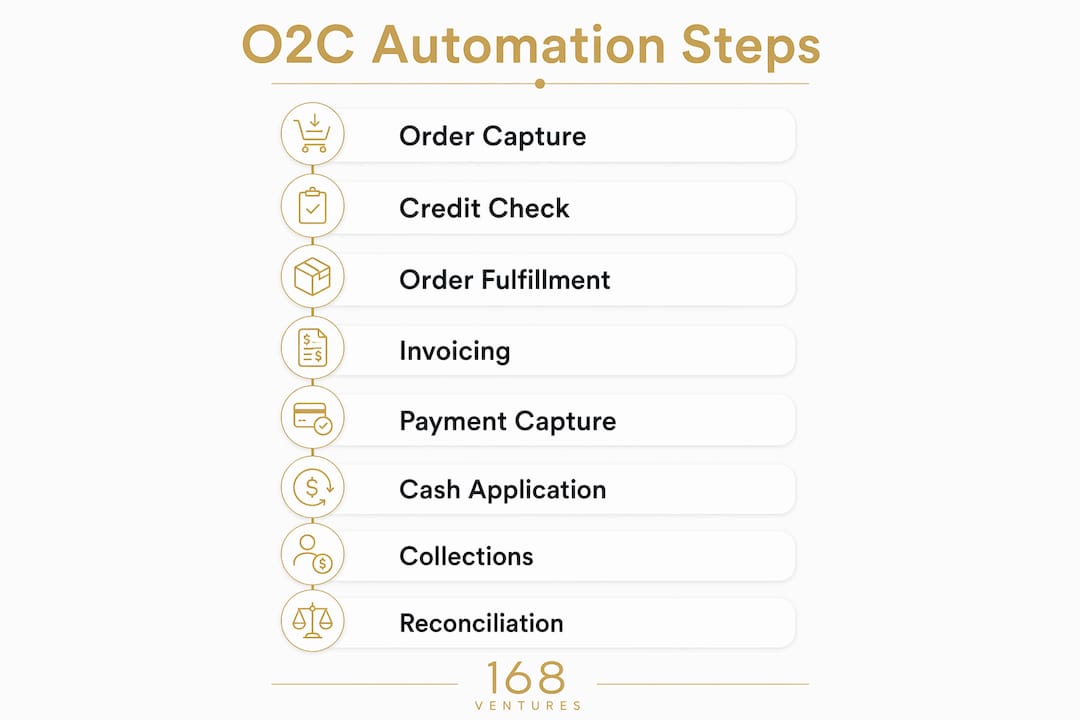
Order fulfillment covers picking, packing, shipping, and the generation of shipping documents. The handoff between your order management system (OMS) and your warehouse management system (WMS) is a common data-gap point.
Invoicing and billing converts the fulfilled order into a receivable. Invoice errors at this stage are the single largest driver of payment disputes and delayed collections.
Payment capture is the moment the customer pays, whether by ACH, wire, card, or check. The payment gateway records the transaction and passes it downstream.
Cash application matches incoming payments to open invoices. Done manually, this is labor-intensive and error-prone, especially with partial payments, deductions, or remittance data arriving in inconsistent formats.
Collections manages the follow-up on overdue accounts. Without automation, collectors spend most of their time on low-balance accounts rather than high-risk ones.
Reconciliation and revenue recognition closes the loop. Payments are matched to the general ledger, revenue is recognized per ASC 606 rules, and the period closes. Delays here push your financial close out by days.
Each stage passes data between sales, operations, finance, and treasury. ERP-centric O2C workflows link these stages to faster revenue recognition and measurable cash flow improvement when automation removes the manual handoffs.
What systems and touchpoints should you automate first?
The O2C process touches at least six distinct systems. Knowing which automation layer belongs to which system is what separates a coherent pilot from a patchwork of disconnected tools.
- Order management system (OMS): Automates order routing, inventory reservation, and fulfillment triggers. The automation touchpoint is rules-based order routing and API-driven status updates back to the sales channel.
- ERP (Enterprise Resource Planning): The system of record for financials. Automation here focuses on automated journal entries, revenue recognition triggers, and period-close workflows.
- IDP for invoice processing: Intelligent document processing uses OCR and AI-driven extraction to capture invoice data from PDFs, emails, and EDI files without manual keying. Automated invoice processing cuts manual data entry, speeds approvals, and improves cash flow visibility for finance teams.
- Payment gateway: Automates payment capture and tokenization. The key touchpoint is real-time payment status passed to the cash-application engine.
- Cash-application engine: Uses a rules engine and ML matching to apply incoming payments to open invoices automatically, including partial payments and deductions.
- Collections engine: Scores accounts by risk and age, then triggers automated dunning sequences (email, SMS, portal reminders) prioritized by balance and payment history.
- Integration and orchestration layer: The connective tissue. An iPaaS or workflow engine (such as Workato) sits between all the above systems, managing API calls, data transformation, and error routing.
- Reporting and analytics: Aggregates KPI data across all stages so finance leadership sees DSO, exception rates, and cash conversion in one dashboard.
Stakeholder ownership matters for pilot alignment. Sales ops owns order capture. Fulfillment owns the OMS-to-WMS handoff. Finance owns invoicing, cash application, and collections. Treasury owns reconciliation. Mapping ownership before you start prevents the governance gaps that derail pilots.

Where does your team sit on the automation maturity curve?
Most finance teams are not starting from zero, but they are also not where they think they are. A four-level maturity model gives you an honest benchmark.
Level 1: Manual
Orders are entered by hand, invoices are keyed from PDFs, cash application is done in spreadsheets, and collections are managed through email threads. DSO is high, error rates are significant, and close cycles are long. The resource cost is almost entirely human labor.
Level 2: Assisted
Some automation exists, typically an ERP with basic AR modules and perhaps a simple dunning email tool. Rules are rigid and require frequent manual overrides. Data still lives in silos. Teams spend significant time on exception handling rather than strategic work.
Level 3: Automated
IDP handles invoice capture. Cash application uses a rules engine with ML matching. Collections are scored and sequenced automatically. The OMS and ERP are integrated via API. Exception queues exist and are managed, but still require human review for edge cases. DSO drops noticeably at this level, and cost-per-invoice falls.
Level 4: Touchless / Autonomous
End-to-end O2C runs with minimal human intervention. AI agents proactively handle procurement and approval workflows end-to-end, lowering manual effort and approval delays. Credit decisions are automated for standard accounts. Reconciliation closes automatically. Human effort concentrates on high-complexity exceptions and strategic decisions. This level requires clean master data, mature integrations, and ongoing model governance.
The jump from Level 2 to Level 3 is where most organizations see the fastest ROI. A 60–90 day IDP and cash-application pilot is the typical mechanism to get there.
What KPIs justify the investment, and how do you build the business case?
Finance leaders need numbers, not promises. These are the KPIs that matter and what automation actually moves.
Market signal: Automated order management software generated nearly $1.66 billion in global revenue in 2025, reflecting strong and growing market adoption for connected, near-real-time order workflows.
| KPI | Definition | What automation improves |
|---|---|---|
| Days Sales Outstanding (DSO) | Average days to collect payment after a sale | Faster invoicing and collections reduce DSO |
| Cost per invoice | Total AR cost divided by invoice volume | IDP and straight-through processing cut this sharply |
| Exception rate | % of transactions requiring manual intervention | Rules engines and ML matching reduce exceptions |
| Order-to-cash cycle time | Days from order placement to cash receipt | End-to-end automation compresses the full cycle |
| Cash conversion cycle | Days to convert inventory investment to cash | Faster O2C directly shortens the cash conversion cycle |
| Dispute backlog | Open disputes by volume and dollar value | Accurate invoicing and automated matching reduce disputes |
To build a credible business case, start with your current baseline for each KPI. Pull 12 months of AR data from your ERP. Calculate your current cost-per-invoice by dividing total AR headcount cost by annual invoice volume. Estimate your DSO using the standard formula: (accounts receivable / total credit sales) × number of days. Then model a conservative improvement scenario, typically a 15–25% DSO reduction and a 30–40% drop in cost-per-invoice, and calculate the working capital freed and labor cost avoided. That delta is your business case numerator. The denominator is implementation cost, which a diagnostic from a partner like 168-ventures can scope precisely.
How do you implement O2C automation from pilot to full scale?
A phased approach reduces risk and builds organizational confidence. Here is a practical sequence.
-
Discovery and data audit (weeks 1–3). Map your current O2C process stage by stage. Identify your highest-volume, most-repeatable transaction types. Audit master data quality: customer master, product master, and pricing tables. Data gaps here will cause automation failures downstream.
-
IDP pilot for invoice capture (weeks 4–8). Deploy an IDP solution against your highest-volume invoice type. Measure extraction accuracy, exception rate, and processing time against your manual baseline. Target straight-through processing above 80% before expanding scope.
-
Cash-application automation (weeks 6–10, overlapping). Implement rules-based and ML-assisted payment matching. Start with your cleanest payment type (ACH with full remittance data) before tackling checks or partial payments. Measure match rate and exception volume daily.
-
Rules-driven collections sequencing (weeks 10–14). Configure a collections engine to score accounts by risk and age. Automate dunning sequences for low-risk, overdue accounts. Free collectors to focus on high-balance, high-risk accounts.
-
Orchestration and reporting (weeks 12–16). Connect the IDP, cash-application, and collections layers through an orchestration platform such as Workato or UiPath. Build a single KPI dashboard that tracks DSO, exception rate, and cost-per-invoice in near-real-time.
-
Scale and continuous improvement (months 5–12). Expand automation to additional invoice types, payment methods, and customer segments. Add predictive collections scoring and anomaly detection. Run monthly KPI reviews and quarterly model retraining.
Quick wins to prioritize first:
- IDP invoice capture (fastest labor-cost reduction)
- Automated cash application for ACH payments (fastest DSO impact)
- Automated payment reconciliation (fastest close-cycle improvement)
Pro Tip: Before you go live on any automation layer, define your exception-handling thresholds explicitly. Decide what confidence score triggers straight-through processing versus a human review queue. Automating without clear thresholds means exceptions pile up unmanaged, which erodes the time savings you built the business case around.
What does a sound O2C technology architecture look like?
The architecture decision that matters most is where you place the orchestration layer. Treating order management automation as a central intelligence layer that anticipates bottlenecks, rather than just digitizing forms, is what separates resilient implementations from brittle ones.
API-first vs. batch integration
API-first integration passes data between systems in near-real-time. A fulfilled order triggers an invoice immediately. A payment captured at 2:00 PM is matched and applied by 2:05 PM. Batch integration runs on a schedule, typically nightly, which means your AR data is always hours behind reality. For O2C, API-first is the right default wherever your ERP and payment systems support it. Batch is acceptable for non-time-sensitive reporting feeds.
Master data hygiene
No automation layer compensates for dirty master data. Before you automate, clean your customer master (deduplicate accounts, standardize billing addresses, validate tax IDs), your product master (consistent SKUs, units of measure, pricing tiers), and your pricing tables. A single pricing mismatch between your OMS and your ERP generates an invoice dispute that takes a human to resolve.
Security and SOX-friendly controls
A short checklist for every O2C automation deployment:
- Role-based access controls on every system that touches financial data
- Immutable audit logs for all automated transactions (who triggered what, when, and with what data)
- Segregation of duties enforced in workflow configuration (the person who approves a credit limit cannot also release a credit hold)
- Encrypted data in transit and at rest for payment and customer data
- Regular access reviews aligned to your SOX control testing calendar
AP automation platforms that combine AI capture, approval workflows, and payments are designed to support regulatory e-invoicing programs, which means the compliance architecture is already built in for many enterprise tools.
Where does AI actually help in the O2C cycle?
AI adds real value in five specific places. Outside these, the ROI case gets thin quickly.
- IDP with ML validation: Machine learning models trained on your invoice formats improve extraction accuracy over time. The key caveat is that model performance degrades when new invoice formats appear that were not in the training set. Plan for quarterly retraining and a human-in-the-loop review queue for low-confidence extractions.
- Predictive collections scoring: ML models score each open receivable by payment-delay probability, using payment history, invoice age, customer segment, and macroeconomic signals. Collectors work the highest-risk accounts first. The data prerequisite is at least 18–24 months of clean payment history per customer segment.
- Anomaly detection for reconciliation: ML flags transactions that deviate from expected patterns, such as a payment applied to the wrong invoice or a duplicate payment. This catches errors that rules engines miss because they fall outside predefined categories.
- Demand forecasting to prevent stockouts: Forecasting models use order history and seasonality signals to anticipate inventory needs, reducing the fulfillment delays that push invoicing back and extend DSO.
- Process mining for root-cause discovery: Process-mining tools (such as UiPath Process Mining) analyze event logs from your ERP and OMS to identify where the actual process deviates from the designed process. This is the fastest way to find the specific handoff causing your DSO spike.
A note on governance: Finance teams operating under SOX or similar frameworks need model explainability, not just accuracy. Before deploying any ML model to an automated decision (credit release, payment matching), document the model's decision logic, establish a human override path, and include the model in your internal audit scope. Model drift is real: a cash-application model trained on pre-pandemic payment behavior may perform poorly on current remittance patterns without retraining.
What governance failures actually kill O2C automation projects?
Most O2C automation failures trace back to the same five root causes, and all of them are preventable.
Poor master data quality is the most common. Automation amplifies data errors rather than correcting them. A duplicate customer record in your ERP means two invoice streams that never reconcile cleanly. Fix the data before you automate.
Missing integration contracts between systems cause silent failures. When your OMS sends an order status update that your ERP does not recognize, the transaction falls into a gap. Define API contracts, error codes, and retry logic before go-live.
Over-automating exceptions is a subtler failure. Teams configure automation to handle 100% of transactions, including edge cases that genuinely need human judgment. The result is automated errors that are harder to catch than manual ones. Build explicit exception queues with SLA targets for human resolution.
Weak change management stalls adoption. Finance teams that were not involved in the design phase will work around the automation rather than through it. Involve AR managers, collectors, and credit analysts in pilot design from week one.
No measurable KPIs from the start means you cannot prove value or diagnose problems. Define your baseline DSO, cost-per-invoice, and exception rate before the pilot begins. Without a baseline, every post-implementation number is just a number.
Governance cadence: Run weekly KPI reviews during the pilot phase. Once in production, monthly reviews are sufficient, with a quarterly deep-dive that includes exception-pattern analysis and model performance assessment. Stakeholder alignment across sales, finance, operations, and IT should be formalized in a steering committee that meets at least monthly during the first year.
Should you build in-house or partner with a vendor?
This decision comes down to four factors: internal capability, speed to value, total cost of ownership, and data ownership. Here is a practical framework.
Build in-house when:
- You have a mature internal engineering team with ERP integration experience
- Your O2C workflows are highly proprietary and cannot be served by configurable platforms
- You have 12–18 months of runway before you need measurable results
- Data sovereignty requirements make third-party processing a compliance risk
Partner when:
- You need results within 90 days
- Your internal team lacks ERP integration or IDP expertise
- You want to de-risk the pilot with a partner who has done this before
- Total cost of ownership for a build is higher than a managed engagement over three years
Evaluation checklist for any vendor or partner:
- Can they show a reference implementation in your industry with documented DSO improvement?
- What is their integration plan for your specific ERP and OMS? Ask for the technical architecture diagram, not a slide.
- What are the SLAs for exception resolution and system uptime?
- How is pricing structured: fixed project fee, per-transaction, or ongoing retainer?
- Who owns the data and the models after the engagement ends?
- What is their security posture? Ask for their SOC 2 Type II report.
Red flags to walk away from:
- A vendor who cannot name the specific integration method for your ERP
- A proposal with no defined KPIs or success metrics
- Pricing tied entirely to transaction volume with no cap
- No clear data lineage or audit trail in their architecture
- A security section that consists of marketing language rather than documented controls
Why the market is moving fast on O2C automation
The investment case for O2C automation is no longer speculative. Automated order management software generated nearly $1.66 billion in global revenue in 2025, a figure that reflects genuine enterprise spend, not pilot budgets.
Market context: The $1.66 billion market valuation for order management automation in 2025 signals that finance teams are moving from evaluation to deployment. Organizations that delay are not holding steady; they are falling behind peers who are already compressing DSO and reducing AR headcount costs.
168-ventures approaches O2C engagements through a three-phase model: a diagnostic audit that maps your current process and identifies the highest-ROI automation opportunities, a focused pilot targeting IDP and cash application, and a scale phase that extends automation across the full O2C cycle. The brand's reported outcome is a typical 3.2x improvement in pipeline within the first 90 days of engagement, a figure that reflects the compounding effect of faster invoicing, better cash application, and reduced exception handling.
For finance leaders who need to present a business case to a CFO or board, 168-ventures can provide a structured pilot ROI model based on your actual baseline data, not industry averages.
How to build a business case your CFO will approve
A strong O2C automation business case has three components: a cost-benefit model, a risk-adjusted ROI, and a stakeholder narrative.
The cost-benefit model starts with your current-state cost. Add up AR headcount cost, the cost of invoice errors and disputes, the working capital tied up in your current DSO, and any late-payment penalties or lost early-payment discounts. Then model the post-automation state using conservative improvement assumptions. A 20% DSO reduction on $10 million in annual receivables frees $548,000 in working capital (assuming a 200-day DSO baseline). That is a concrete number a CFO can evaluate.
Risk-adjusted ROI accounts for implementation risk. Apply a probability-weighted discount to your projected savings based on your data readiness and integration complexity. A clean ERP with good master data warrants a higher confidence factor than a fragmented system landscape.
Stakeholder narrative is where most business cases fail. Finance leaders present numbers; executives make decisions based on narrative. Frame the business case around three questions: What is the cost of inaction (DSO trend, headcount growth, error rate)? What does success look like in 90 days (specific KPI targets)? What is the ask (pilot budget, IT resources, executive sponsor)?
For buy-in from sales leadership, emphasize that faster credit decisions and cleaner invoicing reduce customer friction and disputes. For operations, emphasize that automated order routing and fulfillment triggers reduce expediting costs. Every stakeholder group has a different version of the same ROI story.
How do you sustain automation benefits after go-live?
Automation is not a one-time deployment. Without active monitoring and continuous improvement, performance degrades as business conditions change.
Set up a KPI monitoring cadence from day one. Track DSO, cost-per-invoice, exception rate, and match rate weekly for the first 90 days. Build automated alerts for any KPI that moves more than 10% from baseline in either direction. An unexpected improvement is as worth investigating as a degradation.
Run monthly exception-pattern reviews. Exceptions are not just operational noise; they are diagnostic signals. A spike in cash-application exceptions often means a new payment format has entered your remittance stream. A spike in invoice disputes often means a pricing or product-master data issue. Treat exception patterns as a continuous improvement backlog.
Retrain models on a quarterly schedule. ML models for IDP extraction and collections scoring drift as your customer base, invoice formats, and payment behaviors evolve. Schedule quarterly retraining using the most recent 12 months of data. Document model performance before and after each retraining cycle.
Conduct an annual architecture review. As your business grows, the automation architecture that worked at $50 million in revenue may not scale cleanly to $200 million. Review integration capacity, API rate limits, and orchestration layer performance annually. Identify bottlenecks before they become incidents.
Maintain a continuous improvement backlog. Every exception queue, every manual override, and every workaround is a candidate for the next automation sprint. Assign ownership of the backlog to a named process owner in finance or operations, and review it quarterly with IT and your implementation partner.
Key Takeaways
Order-to-cash automation delivers the fastest, most measurable ROI when you start with IDP and cash application, measure DSO from day one, and treat master data quality as a prerequisite, not an afterthought.
| Point | Details |
|---|---|
| Start with IDP and cash application | These two touchpoints deliver the fastest DSO reduction and cost-per-invoice savings in a 60–90 day pilot. |
| DSO is your primary KPI | Measure days sales outstanding before and after automation; a 15–25% reduction is a realistic 90-day target. |
| Master data quality is a prerequisite | Clean customer, product, and pricing master data before automating; dirty data amplifies errors at scale. |
| Partner when speed matters | If you need results within 90 days and lack ERP integration expertise, a partner engagement outperforms a build. |
| 168-ventures runs diagnostic-to-pilot engagements | 168-ventures offers a structured audit, pilot delivery, and scale roadmap with a reported 3.2x pipeline improvement in 90 days. |
The gap between O2C automation promises and what actually matters
Most O2C automation content focuses on the technology. The tools are real, the capabilities are genuine, and the market adoption numbers back the investment. But the implementations that fail are not failing because of the technology. They fail because the organization treated automation as an IT project rather than a finance transformation.
The most important decision you will make is not which IDP vendor to choose or which orchestration platform to deploy. It is whether your CFO, your AR manager, and your head of sales operations are aligned on what success looks like in 90 days. Without that alignment, the pilot produces data that no one acts on, the business case never gets approved for scale, and the automation sits underutilized while your DSO stays flat.
The second thing most guides understate is the value of exception design. The goal of O2C automation is not to eliminate human judgment. It is to concentrate human judgment where it actually matters: complex disputes, high-value credit decisions, and process improvement. Teams that design their exception queues thoughtfully, with clear SLAs and ownership, outperform teams that chase 100% touchless rates and end up with unmanaged exception backlogs.
If you take one thing from this: the pilot is not a proof of concept for the technology. It is a proof of concept for your organization's ability to operate differently. Run it that way.
What 168-ventures delivers for O2C automation
Finance and operations leaders who have read this far know what good O2C automation looks like. The harder question is whether to build it internally or bring in a partner who has done it before.
168-ventures runs O2C engagements as a full-cycle consulting and delivery partner: operational diagnostic, pilot execution, integration and custom development, and ongoing operational support. The diagnostic identifies your highest-ROI automation opportunities using process-mining and data analysis, not generic benchmarks. The pilot is scoped to 60–90 days with defined KPI targets agreed before work begins. And the scale phase extends automation across the full O2C cycle with a modular architecture that keeps your data secure and your team in control.
The reported outcome across 168-ventures engagements is a 3.2x improvement in pipeline within the first 90 days. For a finance leader building a business case, that is the kind of concrete, short-term signal that gets a CFO's attention.
If you are ready to run a diagnostic or scope a pilot, schedule a conversation with the 168-ventures team. Bring your current DSO and cost-per-invoice numbers. They will bring the roadmap.
Sources and recommended further reading
The following sources were cited in this article and are recommended for deeper reading on O2C automation, IDP, and implementation architecture.
- What is Order to Cash (O2C)? — OpenText: Canonical definition of O2C stages and automation recommendations.
- What Is Order-to-Cash (O2C)? — NetSuite: ERP-centric O2C stage definitions and revenue recognition context.
- Order Management Automation: A Business Guide — Stripe: Market valuation data and adoption context for order management automation.
- Automated Invoice Processing — Workday: IDP and automated invoice processing best practices for finance teams.
- Order-to-Cash Automation for Enterprises — TreviPay: Enterprise O2C automation use cases and cycle simplification.
- Order Management System Software — SAP: Orchestration and intelligence-layer architecture for order management.
- AP Automation Software — Concur: AP automation and regulatory e-invoicing compliance architecture.
- Accounts Payable Automation — Payhawk: AI agent capabilities for end-to-end AP and procurement automation.
- Order-to-Cash Automation — UiPath: Process mining and RPA use cases for O2C finance automation.
- Order-to-Cash Process Guide — Workato: Orchestration and iPaaS integration patterns for O2C workflows.
- 168-ventures: Diagnostic, pilot, and scale engagements for O2C automation; starting point for requesting a structured pilot ROI model.