
Prior authorization automation is the right move for most mid-size and larger healthcare organizations with recurring authorization volume. The immediate next step is a focused pilot lasting several weeks on your highest-volume service lines or medication classes. Before you commit to any vendor, verify three things: auditable decision logic (not black-box predictions), EHR-native integration, and readiness for the CMS-0057-F FHIR API requirements (CRD, DTR, and PAS endpoints) that take effect January 1, 2027. Availity AuthAI and 168-ventures both represent the kind of transparent, implementation-ready approach worth evaluating first.
Table of Contents
- What is prior authorization automation?
- How does prior authorization automation work in practice?
- What operational benefits should executives expect?
- What can you realistically automate, and what should you not?
- What does a pilot-to-rollout roadmap look like?
- How should you evaluate vendors and consulting partners?
- Which KPIs should you track after deployment?
- What risks should you plan for, and how do you mitigate them?
- How 168-ventures approaches prior authorization automation
- Key Takeaways
- The right time to act is now
- What 168-ventures offers: diagnostic and pilot engagement
- Useful sources for further research
What is prior authorization automation?
Automated prior authorization replaces manual intake, fax-based submissions, and phone-queue follow-ups with AI-driven recommendation and submission workflows embedded directly in EHR or payer-gateway systems. Two technical architectures dominate the market.
The first uses codified policy engines, where clinical criteria are expressed as rules in Clinical Quality Language (CQL) and evaluated against structured EHR data. The second uses clinically trained AI models that extract relevant data from unstructured clinical notes and match it against payer criteria. The strongest platforms combine both: rules for clear-cut cases, AI extraction for the messy documentation reality of most health systems.
Automation typically sits at one of three points: inside the EHR as a native workflow, at a middleware orchestration layer connecting providers to many payers at once, or at a vendor portal that providers access separately. Near-real-time recommendation capability is now a baseline expectation, not a differentiator.
Who benefits most:
- Health systems and integrated delivery networks with high PA volume across multiple service lines
- Health plans and PBMs managing utilization management at scale
- Large ambulatory practices with recurring medication or imaging authorizations
- Any organization where PA staff handle more than a few hundred cases per month
How does prior authorization automation work in practice?
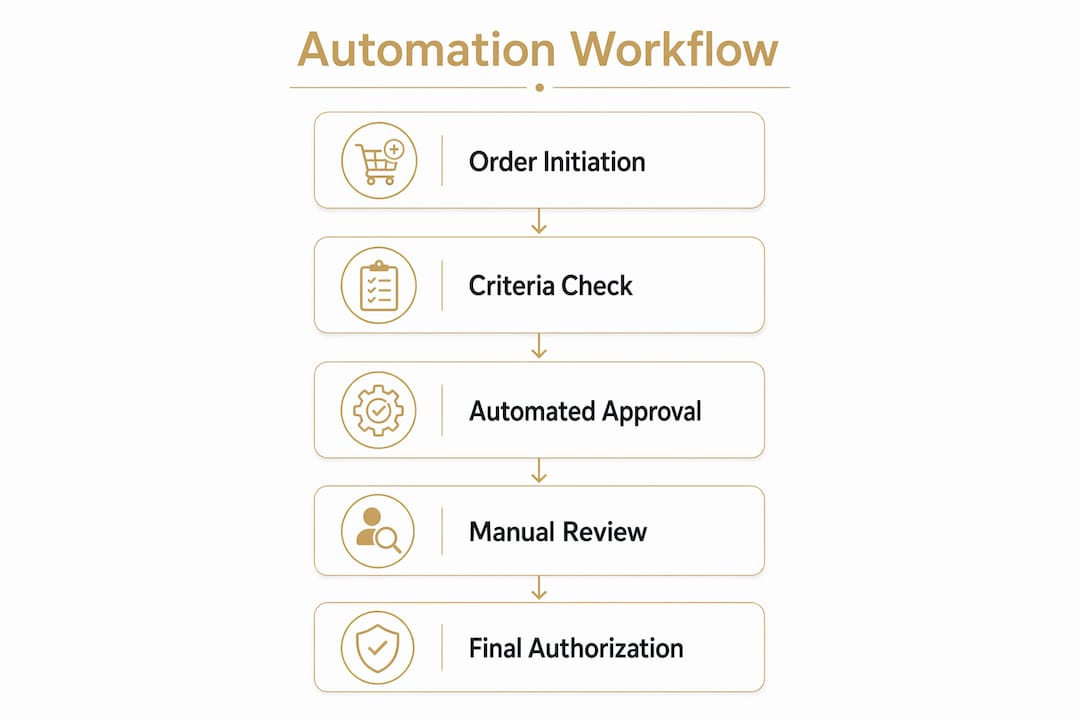
The system functions as a recommendation and submission engine. When a clinician initiates an order, the workflow triggers automatically. Here is the data flow in plain terms: order initiation triggers a Coverage Requirements Discovery (CRD) check, which surfaces whether a PA is needed. If it is, Documentation Templates and Rules (DTR) auto-populate the questionnaire from the patient's chart. Clinical data extraction then pulls relevant values, diagnoses, and notes. Policy evaluation scores the request against payer criteria. Finally, a Prior Authorization Support (PAS) submission goes to the payer, and the response routes back into the EHR.

Availity AuthAI reports average recommendation latency under 90 seconds. That speed matters because it keeps the clinician in their existing workflow rather than forcing a context switch to a separate portal.
Integration models available today:
- EHR-native: lowest clinician friction; requires deeper technical partnership with your EHR vendor
- Middleware orchestration: one-to-many connectivity lets providers connect once and reach multiple payers without point-to-point integrations
- Vendor portal: fastest to deploy but highest workflow disruption; best as a bridge, not a destination
One critical design principle: automation handles approvals when criteria are clearly met. Denials are never automatically issued. When data is insufficient, the system routes the case back to the provider for additional documentation rather than issuing a rejection.
What operational benefits should executives expect?
The primary payoff is speed and labor reduction. Cohere Health's Decision platform reports up to 85% of prior authorization requests approved in real time, depending on specialty and data availability. That figure represents the ceiling for well-implemented programs with strong EHR data quality; your actual coverage rate will depend on how well your clinical documentation is structured.
Beyond the headline number, here is what changes operationally:
- Faster time-to-decision: approvals that took days compress to minutes or seconds for routine cases
- Reduced manual labor: PA staff shift from data entry and phone follow-up to exception management and appeals
- Lower appeals volume: fewer denials for incomplete information mean fewer rework cycles
- Improved patient access: faster approvals reduce treatment delays and abandoned orders
- Clinician burnout reduction: removing PA friction from the ordering workflow is one of the highest-impact changes a health system can make for physician satisfaction
Downstream business impacts include better revenue capture on authorized services, fewer orders abandoned mid-process, and measurable improvements in patient retention tied to access speed.
What can you realistically automate, and what should you not?
Routine, criteria-driven requests are where automation delivers the clearest return. Narrow medication classes with well-defined step-therapy requirements, high-volume imaging orders with codified clinical criteria, and recurring authorizations for chronic therapies are the best pilot candidates. These cases have predictable data needs and payer policies that translate cleanly into rules or trained models.
Complex cases, by contrast, require human judgment. Requests that hinge on individualized medical necessity determinations, rare diagnoses, or multi-condition comorbidities should route directly to clinical reviewers. Automation prompts providers for more information when data is insufficient; it does not make the call for them.
Limitations to plan around:
- Gaps in structured EHR data will cap your automation coverage rate
- Payer-specific policy variance means you need active policy mapping for each payer in scope
- Cases requiring individualized clinical judgment are not automation targets
Pro Tip: Start your pilot with service lines where clinical criteria are already codified in your EHR and where your documentation completion rates are highest. This gives you the fastest path to measurable results and the cleanest data for your go/no-go decision.
What does a pilot-to-rollout roadmap look like?
The recommended sequence is: diagnostic, then a pilot lasting several weeks, then a phased rollout spanning several months with defined go/no-go gates at each stage.
| Phase | Duration | Key Activities |
|---|---|---|
| Discovery & diagnostic | 2–3 weeks | Baseline metrics, EHR data audit, payer mapping, KPI definition |
| Integration & configuration | several weeks | EHR integration test, policy loading, governance setup |
| Pilot run | several weeks | Live automation on scoped service lines, weekly dashboard review |
| Evaluation & scale | several months | Go/no-go gate, phased expansion, ROI re-forecast |
Pilot checklist before go-live:
- Complete a data quality audit on your target service lines
- Confirm EHR integration is tested end-to-end with real patient data (de-identified)
- Map payer policies for every payer in pilot scope
- Define success KPIs and minimum thresholds for go/no-go
- Establish governance: escalation paths, exception routing, and a clinical oversight committee
Measurement baselines to capture before the pilot starts: average decision time, authorization backlog size, first-pass approval rate, and clinician touch-time per case. These four numbers are your before-and-after story. Also confirm your IT team's readiness for CRD/DTR/PAS API connections, since payer onboarding timelines vary and can affect pilot scope.
How should you evaluate vendors and consulting partners?
Lead with four non-negotiable criteria: EHR-native integration depth, auditable and traceable decision logic, FHIR API support (CRD/DTR/PAS), and documented clinical accuracy on cases similar to yours.
Transparent, traceable recommendations using CQL or equivalent policy logic are a hard requirement. Black-box models that cannot explain a recommendation create compliance exposure and clinician distrust. Ask every vendor to show you a sample audit trail before you sign anything.
Prioritized evaluation checklist:
- Automation coverage rate on your specific service lines (not aggregate vendor averages)
- Average recommendation latency under real production load
- EHR integration model: native vs. portal, and what the integration timeline looks like
- Auditability: can you trace every recommendation back to the specific policy rule or data point?
- Deployment model: SaaS, managed service, or on-premises
- Data governance and HIPAA controls, including BAA terms
- Payer coverage list and FHIR PA API connectivity with your top payers
Questions to ask during procurement: What is your median integration timeline for our EHR? Can you provide KPI benchmarks from comparable implementations? How do you handle exceptions and insufficient-data cases? What is your appeals support model?
For consulting partners, evaluate their ability to handle orchestration, custom policy mapping, change management, and executive-level AI integration. 168-ventures uses Oracle as its Executive AI partner to deliver tailored recommendations aligned with your specific operational goals, which is a meaningful differentiator when you need more than a software license.
Which KPIs should you track after deployment?
Track six metrics from day one: time-to-decision, percent of cases automated, first-pass approval rate, clinician touch-time per case, appeals and overturn rate, and total cost of ownership.
- Time-to-decision: for real-time automated approvals, target an average under 90 seconds; for routine cases, under 24 hours
- Percent automated: a well-implemented program on appropriate service lines should reach 60–85% coverage
- First-pass approval rate: track week-over-week to catch policy mapping gaps early
- Clinician touch-time: measure in minutes per case; reduction here is your burnout metric
- Appeals/overturn rate: declining appeals volume signals better upfront accuracy
- Total cost of ownership: include licensing, IT, training, and ongoing policy maintenance
Run weekly pilot dashboards for the operations team, monthly executive reviews with trend lines, and a quarterly ROI re-forecast that compares actual labor savings and revenue capture against your pre-pilot projection.
What risks should you plan for, and how do you mitigate them?
| Risk | Mitigation |
|---|---|
| Poor EHR data quality caps automation rate | Run a data quality audit before pilot; invest in documentation improvement |
| Workflow disruption during rollout | Phased deployment; clinician training before go-live |
| Payer policy mismatch or gaps | Active policy mapping; payer engagement during configuration |
| Opaque "black-box" model decisions | Require auditable CQL-based logic; reject vendors who cannot show audit trails |
| HIPAA and data governance exposure | Confirm BAA terms, data residency, and access controls before contracting |
| CMS API readiness gap | Assess CRD/DTR/PAS readiness now; CMS-0057-F requirements take effect January 1, 2027 |
Operationally, establish a governance committee before the pilot starts. Define SLAs for exception routing, build a clinician training plan, and document your appeals playbook so staff know exactly what to do when automation routes a case for human review.
How 168-ventures approaches prior authorization automation
168-ventures combines a rapid diagnostic, Oracle-backed Executive AI recommendations, and hands-on implementation services to take healthcare organizations from baseline assessment to a running pilot in weeks, not quarters.
The engagement path: diagnostic to identify your highest-value automation targets and data readiness gaps, followed by policy mapping and EHR integration orchestration, then a structured pilot with weekly measurement, and phased scaling once go/no-go criteria are met. Oracle, 168-ventures' Executive AI partner, personalizes the roadmap to your specific service lines, payer mix, and operational constraints rather than delivering a generic vendor playbook.
Clients working with 168-ventures have reported notable improvements in pipeline within the first months of engagement.
Key Takeaways
Prior authorization automation delivers measurable ROI when scoped correctly, piloted with auditable AI, and governed from day one.
| Point | Details |
|---|---|
| Run a diagnostic first | Identify data quality gaps and payer mapping needs before selecting any vendor. |
| Pilot on high-volume, criteria-driven cases | Medication PAs, common imaging, and chronic-therapy authorizations are the fastest path to results. |
| Require auditable logic | Reject any vendor that cannot trace every recommendation to a specific policy rule or data point. |
| Track six core KPIs | Monitor time-to-decision, percent automated, first-pass approval rate, touch-time, appeals rate, and total cost of ownership. |
| Engage 168-ventures for your diagnostic | 168-ventures delivers a fixed-scope diagnostic, Oracle-backed roadmap, and pilot execution to get you to measurable results quickly. |
The right time to act is now
The market for auditable, FHIR-enabled prior authorization AI has matured enough that a well-scoped pilot can produce a clear go/no-go decision within 12 weeks. That was not true two years ago. The CMS-0057-F API mandate, requiring CRD, DTR, and PAS endpoints from regulated payers by January 1, 2027, creates a hard deadline that makes waiting costly. Organizations that start their diagnostic now will have a running program before payers are required to support real-time API connections. Those that wait will be configuring integrations under deadline pressure while competitors are already capturing the efficiency gains.
The cost of inaction is concrete: continued manual overhead, PA staff spending hours on fax and phone follow-up, clinicians interrupted mid-workflow, and revenue delayed or lost on abandoned orders. A 6–12 week pilot costs a fraction of that ongoing drag.
What 168-ventures offers: diagnostic and pilot engagement
Faster authorizations and less administrative drag are achievable without a multi-year implementation. 168-ventures delivers a fixed-scope diagnostic that maps your automation targets, assesses EHR data readiness, and produces a pilot plan with an ROI model and integration checklist, all in weeks.

The diagnostic deliverable includes a prioritized service-line ranking, a payer readiness assessment, a KPI baseline, and a phased rollout roadmap. Oracle, 168-ventures' Executive AI partner, tailors every recommendation to your organization's specific goals and constraints. You leave the diagnostic knowing exactly where to start, what it will cost, and what results to expect.
Start your diagnostic with 168-ventures and move from assessment to a running pilot on a defined timeline.
Useful sources for further research
- Availity AuthAI: The primary reference for auditable AI benchmarks, CMS API readiness, and near-real-time recommendation latency. Review their CRD/DTR/PAS documentation before any vendor conversation.
- Cohere Health Decision: Detailed performance data on real-time approval rates and clinical AI architecture. Useful for benchmarking automation coverage targets.
- Surescripts Prior Authorization Automation: Strong reference for EHR-integrated workflows, pilot outcome data, and the recommendation-engine model.
- DrFirst Electronic Prior Authorization: Focused on EHR-native integration and clinician workflow continuity. Relevant if reducing physician friction is your primary driver.
- 168-ventures consulting and diagnostic services: The recommended starting point for organizations that want a structured diagnostic, Oracle-backed roadmap, and implementation support rather than a standalone software license.
During procurement, verify every vendor's audit trail capability, their payer coverage list against your top 10 payers, and their timeline for CRD/DTR/PAS API readiness. These three checks will eliminate most of the risk before you sign.