
If enterprise buyers are entering your pipeline or you're approaching Series A, pursue SOC 2 now. The single next step: schedule a readiness assessment lasting one to two weeks with your CTO and a compliance partner to map your current controls against the Security Trust Services Criteria. That assessment tells you exactly how far you are from an auditable baseline and what it will cost to close the gap.
Two triggers make the timing clear. First, an enterprise prospect sends a security questionnaire or flags SOC 2 as a procurement requirement. Second, a VC at Series A or B asks for evidence of your security posture. Either signal means the window to start is now, not after the deal is in negotiation.
Pro Tip: Start with the Security criterion only. Adding Availability, Confidentiality, Processing Integrity, or Privacy increases scope, cost, and evidence requirements. Expand only when a customer contract specifically requires it.
Table of Contents
- When does SOC 2 compliance for startups actually make sense?
- What SOC 2 actually assesses and how to scope it for your startup
- What the business benefits of SOC 2 actually look like
- How long it takes and what drives the cost
- How your team prepares: controls, policies, and evidence
- What automation platforms like Vanta, Drata, and Sprinto actually do
- How to choose an auditor or compliance partner
- Common pitfalls and how to stay ready after attestation
- Your 90-day kickoff checklist
- Final verdict and next steps for your leadership team
- Key Takeaways
- Why SOC 2 is a sales problem, not just a security problem
- How 168-ventures gets startups to SOC 2 faster
- Useful sources and references
When does SOC 2 compliance for startups actually make sense?
Start when enterprise buyers enter your pipeline or you commit to SLAs that involve sensitive customer data. Before that point, the compliance work competes directly with product-market fit.
- Pre-seed: Skip it. Engineering time spent on controls is engineering time not spent on the product.
- Seed: Begin thinking about it if enterprise pilots are on the horizon. Run a lightweight gap assessment to understand the lift.
- Series A/B: Start immediately. Enterprise procurement teams expect SOC 2, and a missing report can stall or kill a deal.
Buyer triggers to watch for: a formal security questionnaire, a contract SLA referencing data handling, a procurement checklist from a Fortune 500 prospect, or a VC asking for your security posture documentation. Any one of these is a green light to begin. Practitioner guidance is consistent: premature SOC 2 distracts from product development and delivers little ROI until enterprise demand actually exists.
What SOC 2 actually assesses and how to scope it for your startup
Only Security (the Common Criteria) is mandatory. Every other criterion is optional and should be added only when customer contracts require it.

The five Trust Services Criteria are Security, Availability, Confidentiality, Processing Integrity, and Privacy. Security covers 33 individual criteria and forms the required baseline of any SOC 2 report.
Type I vs. Type II at a glance:
| Report Type | What It Tests | Business Implication |
|---|---|---|
| Type I | Control design at a point in time | Faster, cheaper; rarely the final enterprise requirement |
| Type II | Control operation over 3–12 months | Gold standard; what enterprise procurement actually wants |
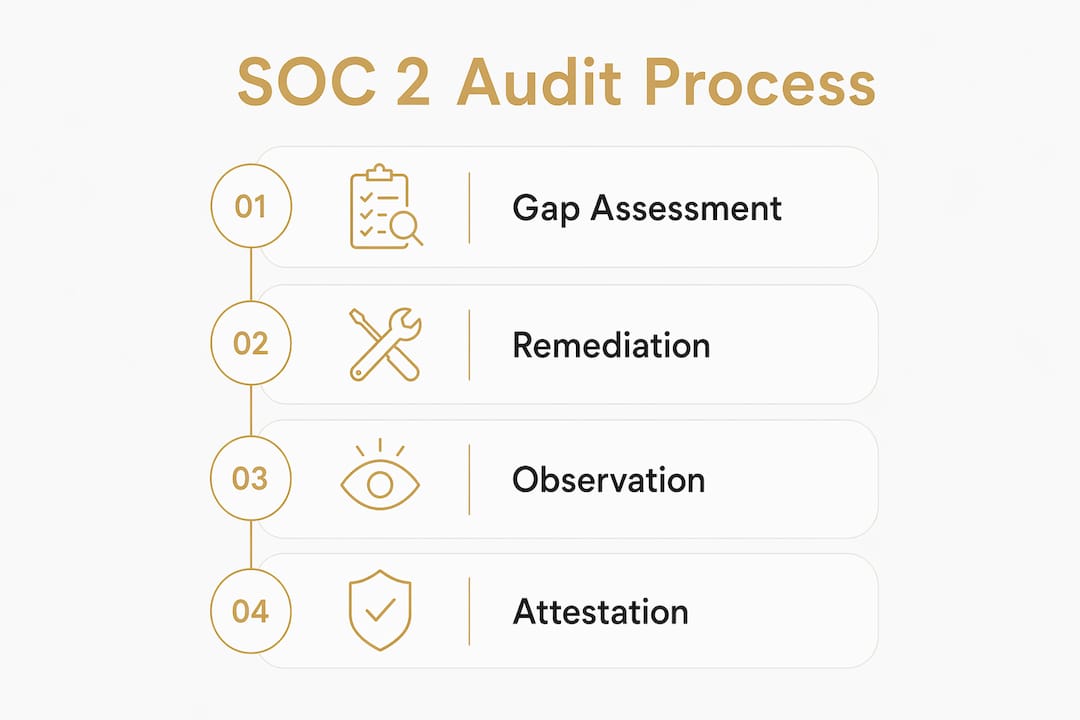
Going directly to Type II is often more cost-effective than doing Type I first, since enterprises will require Type II eventually anyway. Type I makes sense only when a specific deal demands a report immediately and you cannot wait for the observation period.
Scope decision guide:
- Availability: Add when uptime SLAs are contractually defined.
- Confidentiality: Add when contracts explicitly restrict data use or sharing.
- Processing Integrity: Add when your product processes financial transactions or critical workflows.
- Privacy: Add when handling personal data under CCPA, HIPAA, or similar frameworks.
What the business benefits of SOC 2 actually look like
The most direct ROI from SOC 2 is deal acceleration. Without a report, enterprise sales cycles extend because security reviews become manual, repetitive back-and-forths between your team and the buyer's CISO. A clean Type II report short-circuits that process.
Secondary benefits compound over time:
- Removal of procurement gates that block contract execution
- Reduced manual security questionnaire burden on your engineering team
- A trust signal in marketing and sales collateral
- Improved internal operational hygiene as a byproduct of control implementation
Enterprise buyers treat Type II as the standard and typically reject reports older than 12 months, which means SOC 2 becomes an ongoing capability, not a one-time project.
How long it takes and what drives the cost
Realistic end-to-end time to a Type II report typically spans several months, including an observation period that lasts 3–6 months and cannot be shortened by spending more money or deploying more tooling.
| Phase | Duration |
|---|---|
| Gap assessment | a few weeks |
| Remediation and policy work | several months |
| Observation period | 3–6 months |
| Type II audit | several weeks |
First-year costs for a startup can vary significantly depending on scope, tooling choices, and whether you engage a consultant or fractional CISO.
Cost levers you control:
- Scope: Fewer criteria means lower audit fees and less evidence to collect.
- Automation platform: Vanta, Drata, or Sprinto reduce internal labor but add a subscription cost ($10,000–$25,000/year).
- Auditor selection: Boutique auditors with startup experience cost less than Big Four firms and often move faster.
- Internal time: 100–300 engineering hours is typical; automation cuts this significantly.
- Consultant/vCISO: Optional but can prevent costly rework and timeline slips.
How your team prepares: controls, policies, and evidence
Preparation is operational work. Policies must describe what you actually do, and evidence must be demonstrable and repeatable, not assembled the week before the audit.
Core Security controls your team needs to implement:
- Access management with role-based permissions and least privilege
- Multi-factor authentication on all production systems and admin accounts
- Centralized logging and monitoring (CloudTrail, SIEM, or equivalent)
- Change management process with documented approvals and PR protection
- Incident response plan with defined roles and tested procedures
- Vulnerability management with scheduled scans and tracked remediation
- Vendor risk management for third-party services touching customer data
- Employee security training and onboarding/offboarding procedures
Evidence mapping by system:
| Control Area | Where Evidence Lives | Owner |
|---|---|---|
| Access reviews | IDP logs (Okta, Google Workspace) | CTO / IT lead |
| Change management | GitHub branch protection, PR history | Engineering lead |
| Endpoint security | MDM console (Jamf, Kandji) | IT lead |
| Incident response | Documented runbooks, test records | CTO |
| Offboarding | HR system + IDP deprovisioning logs | HR + IT |
Auditors most frequently find gaps in access reviews (undated reviews, slow deprovisioning) and untested disaster recovery plans. Fix those two areas first.
Pro Tip: Pull a sample evidence set before the observation period begins. If you can't produce a clean access review log on demand, your auditor will flag it. Fixing the process early costs far less than a qualified finding in the final report.
What automation platforms like Vanta, Drata, and Sprinto actually do
Automation platforms speed evidence collection and provide continuous monitoring, but they do not replace an independent auditor. The auditor still performs risk-based judgment and human testing of control operation.
What platforms automate:
- Continuous evidence pulls from IDPs, cloud accounts (AWS, GCP, Azure), code repositories, and HR systems
- Alerting when a control drifts out of compliance (e.g., MFA disabled for a user)
- Audit-ready documentation packages that reduce back-and-forth with the auditor
What they don't do: remediate gaps, write policies that match your actual practices, or substitute for the auditor's independent opinion. Compliance automation platforms can cut preparation time roughly in half when used alongside an auditor.
Choosing between Vanta, Drata, and Sprinto: evaluate on integration footprint (which of your existing tools they connect to natively), pricing model (per-seat vs. revenue tier vs. flat subscription), auditor-readiness documentation quality, and implementation effort. Request a proof-of-concept with your actual tech stack before committing.
Pro Tip: Ask each vendor for a reference from a startup that completed a Type II audit using their platform. The reference call will surface integration gaps and timeline realities that sales demos won't.
How to choose an auditor or compliance partner
Pick an auditor with documented startup experience and proof they have audited your tech stack and scoping choices before.
- Ask for two or three anonymized sample reports from startups of similar size and stack.
- Confirm their experience with your chosen criteria and cloud environment.
- Ask how they handle evidence collection access (read-only auditor accounts vs. manual submissions).
- Get a written timeline with milestone dates, not just an estimated total duration.
- Request references from clients who completed Type II, not just Type I.
- Clarify fee structure: fixed vs. hourly, and what triggers scope-change charges.
Hire a consultant or fractional vCISO when your team lacks internal security expertise, when you're on a compressed timeline, or when you want to avoid the rework that comes from common first-timer mistakes. Automation platforms plus a strong internal owner can work without a consultant, but the risk of a delayed or qualified report is higher.
Common pitfalls and how to stay ready after attestation
Most SOC 2 project failures trace back to process and evidence gaps, not missing technology.
Pitfalls to avoid:
- Starting too late (6–12 months is the realistic window; 3 months before a deadline is too late)
- Over-scoping criteria beyond what customer contracts require
- Writing policies that describe aspirational practices rather than actual ones
- Skipping or undating access reviews
- Leaving disaster recovery untested through the observation period
- Ignoring vendor and AI tool risk in your third-party inventory
Annual maintenance checklist:
- Roll evidence collection continuously, not in audit sprints.
- Conduct quarterly access reviews with dated sign-offs.
- Run an annual tabletop incident response test and document results.
- Begin audit planning 3 months before your report expiration date.
- Review and update policies whenever your tech stack or team structure changes significantly.
SOC 2 becomes lower friction each year when evidence collection is automated and controls are embedded in normal engineering workflows rather than treated as a separate compliance project.
Your 90-day kickoff checklist
A focused 90-day plan gets you to an auditable baseline and starts the Type II observation window as early as possible.
- Days 1–14: Run a gap assessment. Owner: CTO + compliance partner. Success metric: written gap report with prioritized control list.
- Days 15–30: Assign control owners and draft the top-priority policies (access management, incident response, change management). Owner: CTO + legal. Success metric: policies reviewed and approved.
- Days 31–45: Deploy or configure security tooling (MDM, MFA enforcement, logging). Owner: Engineering lead. Success metric: all production systems covered.
- Days 46–60: Integrate your automation platform (Vanta, Drata, or Sprinto) with IDP, cloud, and repos. Owner: Engineering lead + IT. Success metric: continuous evidence collection active.
- Days 61–75: Complete a readiness review with your auditor or consultant. Owner: CTO. Success metric: no critical gaps outstanding.
- Days 76–90: Launch the observation period and notify your auditor. Owner: CTO. Success metric: observation start date confirmed in writing.
If timeline slips occur, prioritize access management and logging controls first. Those two areas carry the most audit weight and the fastest remediation path.
Final verdict and next steps for your leadership team
Pursue SOC 2 when enterprise buyers are in your pipeline. The highest-priority next step is a 7–14 day readiness assessment that maps your current state against the Security criterion and produces a prioritized remediation plan.
Three immediate actions:
- Schedule the readiness assessment with your CTO and a compliance partner within the next two weeks.
- Assign an internal owner (typically the CTO or a senior engineering lead) with dedicated time budgeted for the project.
- Run a proof-of-concept with one automation platform using your actual tech stack before signing a contract.
Key Takeaways
A startup that starts SOC 2 when enterprise buyers enter the pipeline, scopes tightly to Security only, and uses an automation platform alongside an independent auditor will reach Type II attestation in 6–12 months with the least disruption to product development. The observation period itself is a fixed 3–6 months and cannot be compressed by tooling or spend.
| Point | Details |
|---|---|
| Start timing | Begin when enterprise buyers appear in your pipeline, not when they ask for the report. |
| Scope tightly | Security is the only mandatory criterion; add others only when contracts require it. |
| Type II is the target | Enterprise procurement treats Type II as the standard and rejects reports older than 12 months. |
| Realistic timeline | End-to-end to Type II takes 6–12 months; the observation period cannot be shortened. |
| 168-ventures approach | 168-ventures runs the readiness assessment, remediation plan, and automation integration so your team stays focused on product. |
Why SOC 2 is a sales problem, not just a security problem
Most founders treat SOC 2 as a compliance checkbox. That framing leads to late starts, over-scoped audits, and reports that arrive after the deal has already moved on. The more useful frame is this: SOC 2 is the document that removes your startup from the "too risky" pile in enterprise procurement. Every week without it is a week where a security questionnaire can stall a six-figure contract.
The observation period is the part that catches most teams off guard. You cannot buy your way through it or automate it away. Controls have to actually operate for 3–6 months before an auditor can attest to their effectiveness. That means the decision to start SOC 2 is really a decision about where you want to be in 9 months. Teams that wait for a deal to demand the report are already 9 months behind.
The other underrated point: automation platforms are labor-saving tools, not audit substitutes. They collect evidence efficiently and alert you to drift, but the auditor's independent judgment is what makes the report credible to a CISO. Buying a platform and assuming the audit is handled is one of the most common and expensive mistakes a startup can make.
How 168-ventures gets startups to SOC 2 faster
Closing enterprise deals without a SOC 2 report is possible until it suddenly isn't. When that moment arrives, you need a partner who can move fast without pulling your engineering team off the product.
168-ventures runs end-to-end SOC 2 readiness engagements: gap assessment, prioritized remediation planning, automation platform integration (Vanta, Drata, or Sprinto), and auditor coordination. Our Executive AI partner, Oracle, maps your specific tech stack and team structure to the controls that matter most, so you're not wasting time on criteria your customers don't require. Clients typically see a 3.2x improvement in pipeline within the first 90 days of a structured engagement. Book a diagnostic session with 168-ventures and get a clear readiness timeline before your next enterprise conversation.
Useful sources and references
- AICPA Trust Services Criteria: Authoritative mapping of all five TSCs to required controls and evidence. Use this when evaluating auditor scope proposals.
- IOmergent SOC 2 for Startups Guide: Practical timeline and cost breakdown, including phase-by-phase milestones and common mistakes. Useful for building your internal project plan.
- Chiaro SOC 2 for Startups: Practitioner guidance on scoping, timing, and cost ranges. Strong on the "when not to do SOC 2" argument for pre-seed teams.
- Vanta SOC 2 Compliance Requirements: Platform-side view of evidence collection automation and integration footprint. Useful when evaluating automation platforms.
- Workstreet SOC 2 for Startups: Practitioner case for going directly to Type II and skipping Type I as a standalone milestone.